Can AI Make You More Productive? Here's What Happened When I Tried It Can AI make you more productive? It's a question many people are asking as artificial intelligence becomes part of everyday life. From writing emails and organizing schedules to generating ideas and automating repetitive tasks, AI promises to help us work faster and …
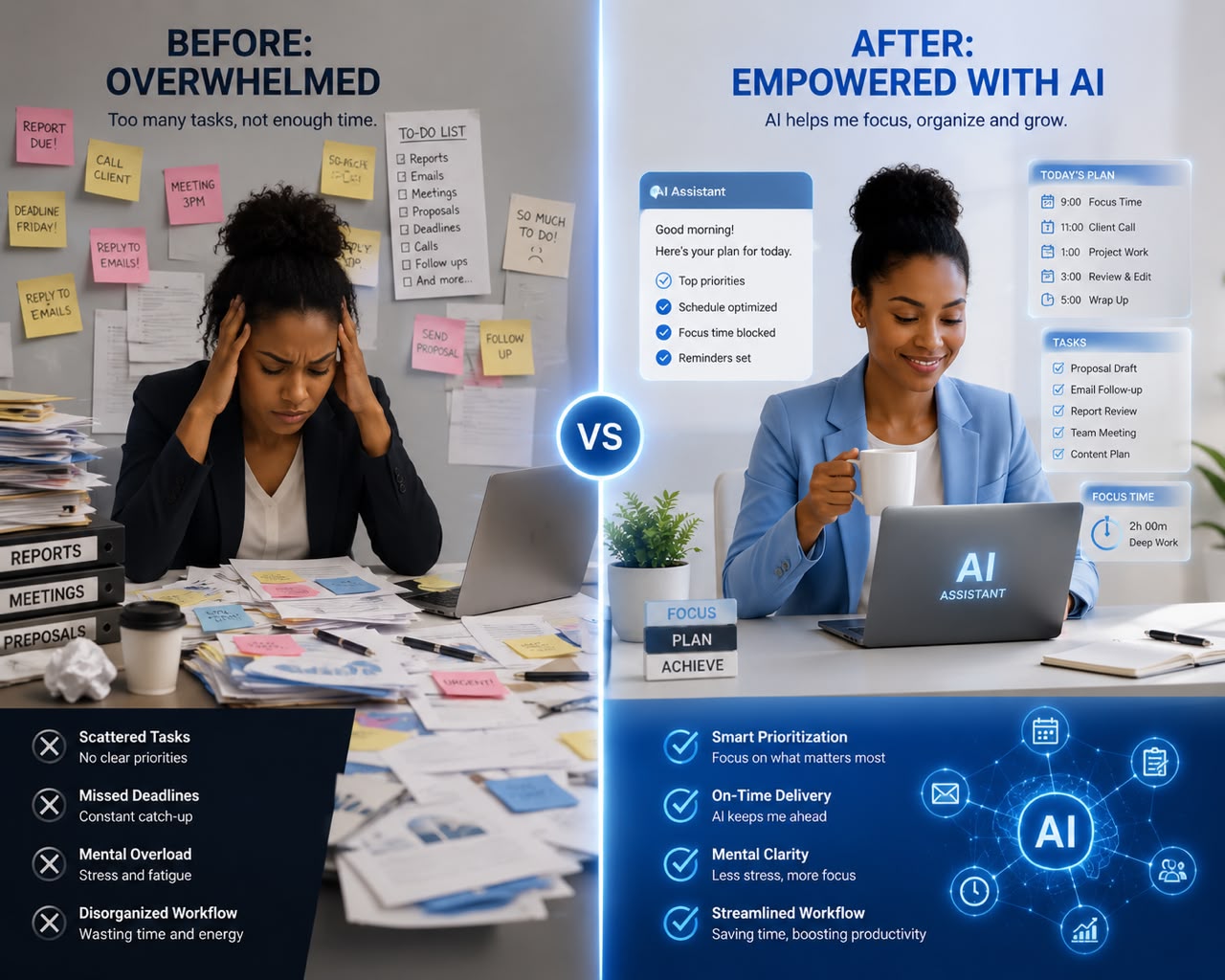
Can AI Make You More Productive? Here’s What Happened When I Tried It
Can AI make you more productive? It’s a question many people are asking as artificial intelligence becomes part of everyday life. From writing emails and organizing schedules to generating ideas and automating repetitive tasks, AI promises to help us work faster and smarter. But does it actually deliver?
I decided to put AI to the test by incorporating it into my daily workflow for routine tasks. While this isn’t a scientific experiment, it reflects the experience many professionals, students, freelancers, and entrepreneurs have when they begin using AI intentionally.
The results were surprising—not because AI did everything for me, but because it changed how I approached my work.
Why I Decided to Try AI
Like many people, I often found myself spending too much time on small tasks that added up throughout the day. Writing emails, organizing notes, brainstorming ideas, and searching for information all took valuable time away from more meaningful work.
I wasn’t looking for AI to replace my thinking. Instead, I wanted to see if it could reduce repetitive work and help me focus on the tasks that required creativity, decision-making, and problem-solving.
So, for one week, I used AI whenever it made sense.
What I Used AI For
Rather than depending on AI for everything, I chose practical tasks where it could genuinely save time.
These included:
- Drafting emails
- Brainstorming blog topics
- Summarizing long articles
- Organizing daily to-do lists
- Planning content ideas
- Rewriting rough notes
- Creating meeting agendas
- Researching unfamiliar topics
These are activities that many people perform regularly, making them ideal opportunities to test AI’s usefulness.
What Happened
1. I Spent Less Time on Routine Tasks
One of the biggest improvements was the amount of time saved on repetitive work.
Instead of staring at a blank page when writing an email or planning a blog post, AI provided a starting point within seconds.
The suggestions weren’t perfect, but having a first draft made it much easier to edit and personalize the final version.
This reduced the time spent on routine tasks and helped me move on to higher-value work more quickly.
2. Brainstorming Became Easier
Everyone experiences creative blocks from time to time.
Whenever I struggled to come up with ideas, AI generated multiple suggestions that sparked new directions.
Not every idea was worth using, but even average suggestions often inspired better ones.
Rather than replacing creativity, AI became a brainstorming partner.
3. I Still Needed to Think Critically
One important lesson became clear very quickly:
AI isn’t always correct.
Some responses required fact-checking, editing, or additional context.
This reinforced an important principle: AI should assist your thinking—not replace it.
Human judgment remains essential, especially when making decisions, publishing content, or communicating with clients.
4. My Daily Planning Improved
AI also helped organize my day.
By listing my tasks and priorities, I could ask AI to suggest a logical schedule based on deadlines and estimated completion times.
While I occasionally adjusted the plan, having a structured starting point reduced decision fatigue and helped me stay focused.
Instead of wondering what to do next, I simply followed my prioritized list.
5. I Had More Time for Meaningful Work
Perhaps the biggest benefit wasn’t simply saving time—it was how I used the time I gained.
Instead of spending hours formatting documents or searching for information, I had more opportunities to:
- Solve problems
- Learn new skills
- Improve projects
- Connect with clients
- Think strategically
- Review my work carefully
AI handled the repetitive parts so I could focus on the work that required human insight.
What AI Could Not Do
Although AI proved helpful, there were clear limitations.
It couldn’t fully understand personal experiences, emotions, or business relationships.
It couldn’t replace:
- Critical thinking
- Emotional intelligence
- Leadership
- Creativity
- Ethical decision-making
- Personal judgment
These remain uniquely human strengths.
AI works best when it supports your expertise—not when it attempts to replace it.
Tips If You Want to Try AI
If you’re curious about using AI to improve productivity, start small.
Here are a few practical ideas:
Use AI for First Drafts
Whether you’re writing emails, reports, or blog posts, let AI generate an initial version that you can edit.
Automate Repetitive Tasks
Use AI to summarize meetings, organize notes, or create task lists.
Brainstorm Ideas
Ask AI to generate multiple perspectives whenever you’re stuck.
Learn Faster
Use AI to explain difficult concepts or summarize lengthy documents.
Always Review the Results
Never assume AI is completely accurate. Verify facts, add your own expertise, and personalize the final output.
The Biggest Lesson I Learned
The experiment changed the way I think about AI.
Before trying it, I viewed AI as another productivity tool.
After using it consistently, I realized it’s better described as a digital assistant.
It doesn’t eliminate work.
It removes unnecessary friction.
Instead of spending hours on repetitive tasks, you can devote more energy to meaningful work, better decisions, and continuous learning.
That’s where the real productivity gains happen.
Final Thoughts
Can AI make you more productive? Based on my experience, the answer is yes—but with an important condition.
AI works best when you use it to support your skills rather than replace them. It can help you write faster, organize your day, generate ideas, and automate routine work, but your creativity, judgment, and expertise remain irreplaceable.
The goal isn’t to let AI do all the work. The goal is to let AI handle repetitive tasks so you can focus on what humans do best: thinking critically, solving problems, building relationships, and creating value.
If you approach AI as a helpful partner instead of a shortcut, you may find that it becomes one of the most valuable productivity tools in your daily routine.