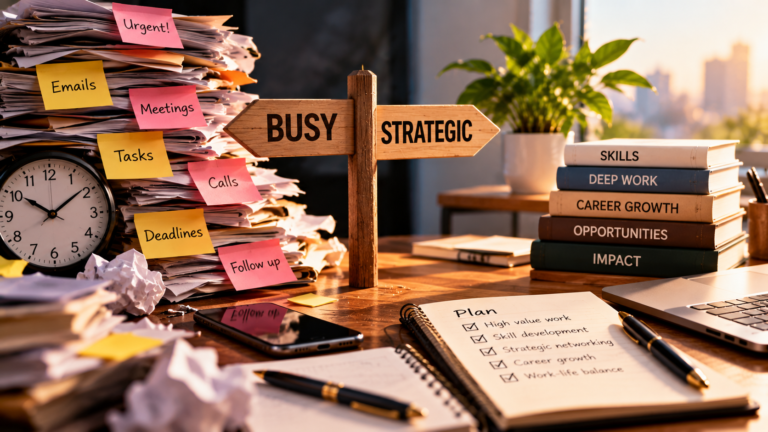
The New Career Advantage: Becoming a Person Who Can Work With AI Work with AI is quickly becoming one of the most useful career skills you can develop. You don't need to be a programmer, build robots, or understand complicated machine-learning models to benefit from artificial intelligence. You simply need to understand how to use …

The New Career Advantage: Becoming a Person Who Can Work With AI
Work with AI is quickly becoming one of the most useful career skills you can develop. You don’t need to be a programmer, build robots, or understand complicated machine-learning models to benefit from artificial intelligence.
You simply need to understand how to use AI to make your existing skills more valuable.
Think about the difference between someone who spends two hours creating a first draft from scratch and someone who uses AI to create a starting point, checks the information, improves the ideas, and finishes the work in a fraction of the time.
The second person isn’t necessarily more talented.
They’ve learned how to work with AI.
And that ability is becoming a genuine career advantage.
AI Is Changing How Work Gets Done
Artificial intelligence is already being used for tasks such as research, writing, summarizing, brainstorming, data analysis, customer support, scheduling, content creation, and information management.
But here’s the important distinction:
AI doesn’t have to replace a job to change a job.
A role can remain valuable while the way that role is performed changes dramatically.
For example, an executive assistant may use AI to summarize meeting notes, draft routine emails, organize information, or prepare research. A marketer might use it to brainstorm campaigns and analyze customer feedback. A designer might use AI to explore concepts before developing the final creative work.
The person still brings judgment, context, communication, and expertise.
AI simply helps them work more efficiently.
The Advantage Isn’t Knowing Every AI Tool
You don’t need to chase every new AI application that appears online.
In fact, trying to learn everything can become overwhelming.
The more useful skill is understanding how AI can solve problems.
Instead of asking:
“Which AI tool should I learn?”
Ask:
“What takes too much time in my current work?”
Maybe you spend hours researching.
Maybe writing first drafts slows you down.
Maybe you repeatedly organize information.
Maybe you spend too much time preparing reports.
Maybe you struggle to turn scattered ideas into a clear plan.
Those are opportunities to experiment with AI.
Learn AI Through Your Existing Skills
One of the easiest ways to learn to work with AI is to start with something you already know.
If you’re a virtual assistant, experiment with AI for research, email drafting, meeting preparation, calendar organization, and documentation.
If you’re a content creator, use it for brainstorming, outlines, content repurposing, research, and editing.
If you’re in customer service, explore how AI can help organize FAQs, summarize customer interactions, or create response drafts.
If you’re a business owner, experiment with market research, planning, customer communication, and administrative tasks.
You don’t need to become an AI specialist.
You need to become someone who knows how to combine your skill + AI.
Human Skills Still Matter
As AI becomes more capable, human judgment becomes increasingly important.
AI can produce an answer, but can it understand your client’s personality?
Can it recognize when something doesn’t sound right?
Can it take responsibility for an important decision?
Can it understand the emotional context of a difficult conversation?
Can it determine whether an idea is actually appropriate for your business?
That’s where human skills matter.
Communication, critical thinking, creativity, emotional intelligence, problem-solving, leadership, adaptability, and industry knowledge remain extremely valuable.
The strongest professionals won’t necessarily be the people who let AI do everything.
They’ll be the people who know what AI should do and what they should do themselves.
Learn to Give Better Instructions
Another important part of learning to work with AI is learning how to communicate with it effectively.
Vague instructions often produce vague results.
Instead of saying:
“Write an email.”
You might explain the audience, purpose, tone, important details, desired length, and outcome.
The better you understand the problem you’re trying to solve, the better you can guide the technology.
This is why AI literacy isn’t simply about writing clever prompts.
It’s about thinking clearly enough to explain what you need.
Always Review the Output
AI can be incredibly useful, but it isn’t automatically correct.
It can misunderstand instructions, invent information, make calculations incorrectly, or produce something that sounds convincing but isn’t appropriate.
That means you still need to check the work.
Think of AI as a highly capable assistant whose work requires supervision—not an unquestionable authority.
Your responsibility is to review, fact-check, edit, and apply your own judgment.
Turn AI Skills Into Career Proof
Don’t just say that you know how to use AI.
Show people what you can do with it.
Create a small portfolio project.
For example, demonstrate how you used AI to:
- Research and organize information
- Create a content workflow
- Improve an administrative process
- Build a customer-service knowledge base
- Summarize and structure meeting information
- Create a repeatable business workflow
- Reduce the time required for a repetitive task
This gives employers or clients something more valuable than a statement on your résumé.
It gives them evidence.
The Future Belongs to Adaptable Professionals
You don’t need to predict exactly what the job market will look like five years from now.
You need to become comfortable learning new tools and adapting when the way work is done changes.
That is the real career advantage.
Learning to work with AI doesn’t mean competing against technology. It means learning how to use technology to become more capable.
Your experience still matters.
Your creativity still matters.
Your judgment still matters.
Your ability to understand people still matters.
Now, you have another tool that can help you put those strengths to work.
Don’t wait until AI becomes a requirement for your job. Start learning how to work with it while you still have the opportunity to make it your advantage.