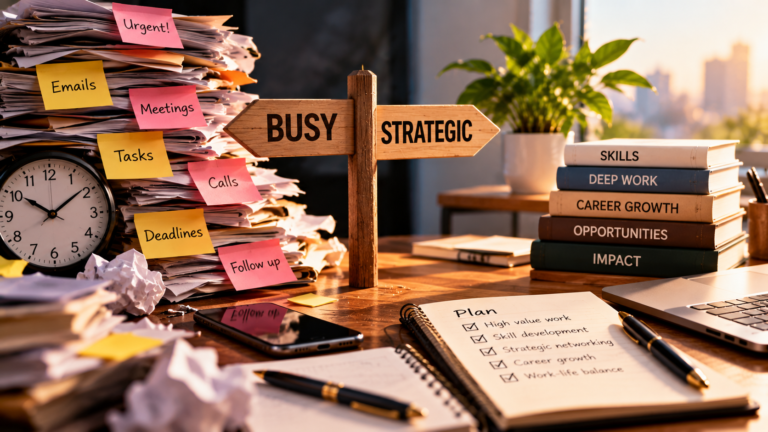
The Hidden Exhaustion of Constantly Switching Between Tasks Task switching can make you feel productive while quietly draining your attention. You start writing an email. A notification appears. You check it. Then you remember you need to send a document, so you open another tab. While searching for the document, you notice a message from …

The Hidden Exhaustion of Constantly Switching Between Tasks
Task switching can make you feel productive while quietly draining your attention.
You start writing an email.
A notification appears.
You check it.
Then you remember you need to send a document, so you open another tab.
While searching for the document, you notice a message from a client.
You respond.
Then you return to your email and realize you’ve forgotten what you were about to say.
By the end of the day, you’ve touched twenty different tasks—but somehow, very little feels finished.
Sound familiar?
The problem may not be that you’re lazy, distracted, or incapable of managing your time.
You may simply be asking your brain to change direction too often.
What Is Task Switching?
Task switching happens when you move your attention from one activity to another.
Sometimes switching is necessary. Emergencies happen. Meetings interrupt your work. A client needs an immediate response.
But constantly switching between unrelated tasks can make your work feel much more exhausting.
You might move from writing to email, from email to social media, from social media to research, then from research to household responsibilities.
Every time you change direction, your attention has to adjust.
Even when each individual task seems small, the repeated switching can make your day feel mentally heavy.
Why Multitasking Feels Productive
The problem is that multitasking often looks productive.
Your laptop has several tabs open.
Your phone is beside you.
Your inbox is being answered.
Your messages are being checked.
Your project is open.
You feel busy.
But being busy isn’t the same as making meaningful progress.
When you’re constantly moving between tasks, you may spend more time getting back into the right mental context than actually doing the work.
Instead of giving one task your full attention, you’re repeatedly restarting your concentration.
Every Switch Has a Cost
Imagine you’re writing an important report.
You’ve finally developed a good train of thought.
Then you check a message.
It takes two minutes.
You return to the report.
Now you have to remember where you were, what you were thinking, and what you planned to write next.
That process happens again when another notification appears.
The interruption itself may only take a few seconds.
The bigger cost is rebuilding your concentration afterward.
Multiply that by dozens of interruptions throughout the day, and you can understand why a few hours of work can leave you feeling completely exhausted.
Constant Switching Can Make Simple Tasks Feel Difficult
When your attention is fragmented, even ordinary tasks can feel harder than they should.
You may read the same paragraph several times.
Forget what someone just told you.
Make small mistakes.
Lose track of deadlines.
Take longer to finish routine work.
Feel overwhelmed by a relatively short list of responsibilities.
This doesn’t necessarily mean the work has become harder.
Your attention may simply be spread too thin.
Try Batching Similar Tasks
One practical way to reduce task switching is to group similar activities together.
Instead of checking messages every few minutes, choose specific times to respond.
Instead of researching throughout the entire day, create a dedicated research block.
Instead of constantly jumping between administrative tasks and creative work, group your administrative tasks together.
For example:
9:00–10:30 — Focused work
10:30–11:00 — Emails and messages
11:00–12:30 — Project work
12:30–1:00 — Administration
The exact schedule doesn’t matter.
The principle is simple:
Give similar tasks a home.
Protect Your Deep Work
Some tasks require more concentration than others.
Writing, designing, analyzing, planning, studying, coding, strategic thinking, and creative work usually benefit from uninterrupted attention.
Try protecting a block of time for these activities.
Turn off unnecessary notifications.
Put your phone away if possible.
Close unrelated tabs.
Let people know when you’re unavailable for non-urgent requests.
You don’t need to disappear for eight hours.
Even one uninterrupted hour can be valuable when you’re working on something mentally demanding.
Not Every Notification Deserves Your Attention
Modern technology has trained many of us to react immediately.
A message arrives.
We check it.
An email appears.
We open it.
An app sends a notification.
We look at it.
But most notifications aren’t emergencies.
Ask yourself:
Does this require my attention right now?
If not, you can return to it later.
Turning off unnecessary notifications can remove dozens of decisions and interruptions from your day.
Create a “Distraction List”
Sometimes the interruption comes from your own brain.
You’re working on one task when you suddenly remember:
“I need to book that appointment.”
“I should check that price.”
“I need to reply to Sarah.”
“I just had an idea for a new project.”
Instead of immediately switching tasks, write the thought down.
Keep a small notebook or digital list nearby.
Capture it and return to what you were doing.
This gives your brain reassurance that the thought hasn’t been forgotten without allowing it to hijack your current task.
Give Yourself Permission to Finish One Thing
There is something satisfying about completing a task before moving on.
Instead of asking:
“What else can I do?”
try asking:
“What can I finish?”
Finishing creates momentum.
It reduces the number of open loops in your mind and gives you a clearer sense of progress.
You don’t need to complete every task before touching another one.
But you can become more intentional about when and why you switch.
Your Energy Matters Too
Productivity isn’t only about how many hours you have.
It’s also about how much mental energy you have available.
If you spend your entire morning reacting to messages, notifications, emails, errands, and interruptions, you may reach your most important work already mentally tired.
Protect your attention for the tasks that require the best version of you.
Let routine tasks happen during lower-energy periods when possible.
Build a Calmer Way to Work
Task switching will always be part of modern life.
You can’t eliminate every interruption, and you shouldn’t try to create a perfectly controlled day.
But you can reduce unnecessary switching.
Batch similar tasks.
Protect focused work.
Silence unnecessary notifications.
Capture distractions instead of following them.
And give yourself permission to concentrate on one meaningful thing at a time.
Because sometimes the reason you’re exhausted at the end of the day isn’t that you worked too little.
It’s that your attention had to change direction too many times.
A calmer workflow may not mean doing less.
It may simply mean stopping your brain from starting over every few minutes.